

Functional Fats: Why Whole-Food Coconut Beats Processed Energy Oils
A formulation decision that most brands would bury quietly. Here's why we made it, and why the science says it was the right call.
There's a version of this article that doesn't get written.
The version where a supplement brand quietly reformulates, swaps an ingredient, updates the label, and says nothing — banking on the assumption that nobody reads ingredient lists closely enough to notice, or that anyone who does can be redirected by a sufficiently vague claim about "improved bioavailability" or "enhanced formula."
That's not this article.
We removed pure MCT oil powder from our formulation. We replaced it with dehydrated coconut milk powder. The reasons are specific, grounded in both food science and user experience, and they represent a deliberate upgrade — not a cost-cutting compromise or a quiet retreat from a previous claim. This is what happened and why.
What MCT Oil Powder Actually Is
Medium-chain triglycerides — MCTs — became a fixture of keto and performance nutrition for legitimate reasons. Fats with carbon chain lengths of 8 to 12 carbons behave differently in the body than the long-chain fats found in most animal and plant foods. They are absorbed directly through the portal vein to the liver rather than traveling through the lymphatic system, which means they bypass the slow emulsification process that makes long-chain fats a poor source of quick energy. The liver converts them rapidly into ketone bodies or uses them directly for oxidative fuel. In theory: fast, clean energy with minimal storage tendency.
The problem is what "MCT oil powder" actually means on a manufacturing level.
Pure MCT oil is a liquid — a clear, odorless refined oil typically derived from fractionated coconut or palm kernel oil. To make it a powder suitable for inclusion in a dry-mix supplement, manufacturers must bind the oil to a carrier. The most common carrier is maltodextrin — a highly processed starch derivative with a glycemic index that typically exceeds table sugar. Some producers use tapioca starch or acacia fiber as alternatives, but maltodextrin remains dominant because it's cheap and produces a clean-flowing powder.
The result is a product that bills itself as a fat supplement but delivers a meaningful portion of its calories as rapidly metabolized refined carbohydrate — the exact energy dynamic that MCTs are supposed to replace. For a keto athlete tracking net carbs with any seriousness, or a wellness purist who reads ingredient labels as a matter of principle, this is a material deception embedded in the product's fundamental structure.
Beyond the carrier issue, there's the concentration problem. Pure MCT oil powder, designed to maximize MCT content, delivers isolated fractions of coconut-derived fatty acids — typically C8 (caprylic acid) and C10 (capric acid), with lauric acid largely removed because it behaves more like a long-chain fat in the body. In high concentrations, and without the buffering effect of a whole-food matrix, these isolated fractions cause predictable gastrointestinal distress: cramping, urgency, and diarrhea, particularly at the doses required to deliver meaningful energy effect. The research literature on MCT supplementation is peppered with GI adverse event data. It is the most commonly reported side effect, and it is dose-dependent. Athletes who want MCTs for performance have to play a careful game of finding the threshold below which they get some benefit without spending the training session near a bathroom.
That is not a feature. It is a design flaw.
What Dehydrated Coconut Milk Powder Actually Is
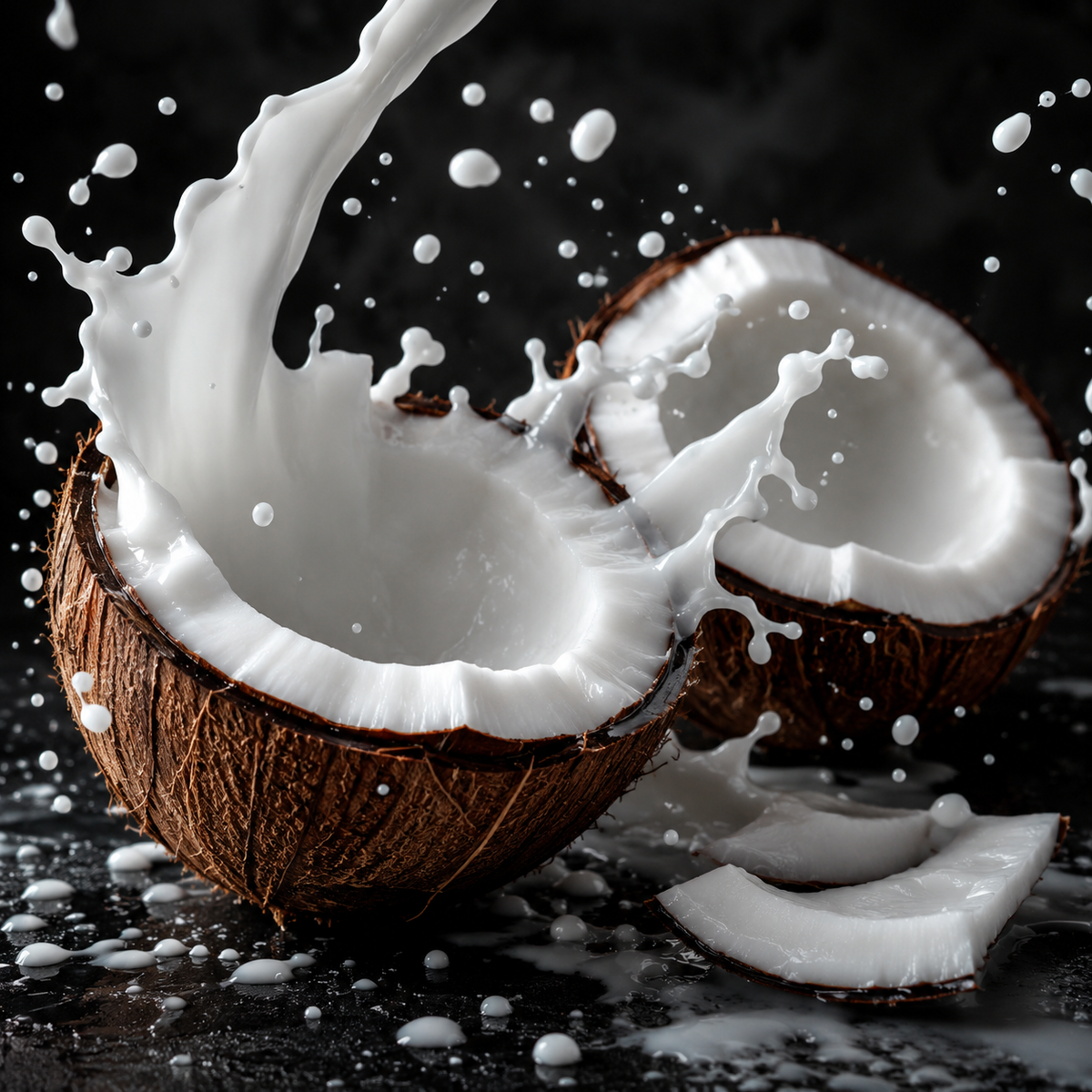
Coconut milk — the liquid extracted from grated mature coconut flesh — is a whole food. It contains water, medium-chain fatty acids, small amounts of natural sugar, trace minerals including potassium and magnesium, and the microstructural complexity of a fat embedded in a living food matrix rather than fractionally distilled from it.
Dehydrated coconut milk powder is made by removing the water from that liquid under controlled conditions, producing a shelf-stable powder that retains the fatty acid profile and much of the micronutrient content of the original whole food. Critically, it retains lauric acid — typically comprising around 40–50% of coconut fat — along with C8 and C10 fractions in their naturally occurring ratios.
This matters for several reasons.
Lauric acid occupies a contested position in nutrition science — it is technically a medium-chain fatty acid by carbon count (C12), but metabolizes somewhat differently than C8 and C10, with partial absorption through the lymphatic system rather than purely through portal vein transport. What is not contested is its biological activity. Lauric acid has well-documented antimicrobial properties, is a component of human breast milk, and does not appear to raise LDL cholesterol in the manner of long-chain saturated fats from animal sources. In the context of a whole coconut food matrix, where it arrives alongside other fatty acids, fiber traces, and micronutrients, its absorption is modulated by that matrix rather than occurring as an isolated chemical event.
This is the core distinction between whole-food coconut fat and processed MCT oil powder: the matrix effect. Nutrients absorbed from whole foods behave differently than the same nutrients delivered in isolated, concentrated form. The fat in coconut milk arrives embedded in a food structure that includes proteins, carbohydrates, and trace compounds that collectively influence how quickly the fat is absorbed, how it is metabolized, and how the gut responds to it.
The practical consequence: coconut milk powder delivers MCTs — real, functional medium-chain fats — at concentrations that provide genuine energy and satiety benefit, without the concentrated-dose GI disruption that makes pure MCT oil powder so problematic for sensitive users. The energy is real. The mouthfeel is rich and creamy. The stomach response, for the vast majority of users, is nothing — which is exactly what you want from a fat source that's supposed to be quietly doing its job in the background.
The Keto and Paleo Case for Whole-Food Fat
The ketogenic and paleo dietary frameworks share a foundational principle that tends to get lost in the supplement version of those diets: whole-food sourcing matters not just as an ethical position but as a metabolic one.
A paleo template that includes pure MCT oil powder — a product that didn't exist in any ancestral food environment and requires significant industrial processing to manufacture — is using paleo branding to sell something antithetical to the framework's underlying logic. Coconut, by contrast, is one of the most paleo-credible foods on the planet: a calorie-dense, shelf-stable whole food that sustained island populations for millennia and requires nothing more sophisticated than drying to convert into a powder.
For keto athletes, the carrier-carbohydrate problem with maltodextrin-based MCT powder is a legitimate concern that coconut milk powder largely sidesteps. The carbohydrates present in coconut milk powder come from the coconut itself — naturally occurring sugars and trace starches that arrive in context with fat and minor fiber, moderating their own absorption rather than spiking blood glucose the way pure maltodextrin does.
For wellness purists and ingredient-label readers — the people who know what tapioca maltodextrin is and why it's in their "fat supplement" — dehydrated coconut milk powder is simply a cleaner answer. One ingredient. Recognizable origin. No industrial fractionation, no carrier chemistry, no fine-print carbohydrate disclosure.
Transparency as a Formulation Principle
Reformulating is a normal part of developing a serious food product. Ingredients get better, supply chains change, and — if you're paying attention to the research and to what users are actually experiencing — you update accordingly.
The MCT powder removal was driven by two things: the GI distress pattern that concentrated isolated MCTs produce at meaningful doses, and the philosophical inconsistency of using a heavily processed ingredient inside a product built around whole-food protein sources.
Coconut milk powder solves both problems. It delivers functional medium-chain fats from a whole-food source, in ratios that the body handles smoothly, with a creamy richness that makes a savory sauce taste the way a savory sauce should taste — without the trade-offs that made the previous formulation a compromise hiding behind a marketing claim.
The label reflects what's actually in the product now. That's how it should work.
Leave a comment
This site is protected by hCaptcha and the hCaptcha Privacy Policy and Terms of Service apply.