

Why Hollywood's Top Actors Hate Their "Superhero Diets" (And How to Fix It)
The chicken-and-broccoli lockup is breaking people. Here's what the science says about eating for performance without punishing yourself.
There's a moment in nearly every superhero press tour where the interviewer asks the question everyone is thinking: what did you have to eat to look like that?
And the answer is almost always some variation of the same brutal, joyless confession.
Chris Hemsworth, who has spent a decade alternating between bulking and shredding to play Thor, has been candid about the psychological grind of his transformation diets — thousands of calories of lean chicken, rice, and egg whites, eaten five or six times a day, every single day, for months on end. He's described the process as mentally exhausting, something closer to a medical protocol than a meal. "It gets to a point where it's not enjoyable anymore," he's said in various interviews, his frustration barely concealed behind the laugh.
Chris Evans echoed similar sentiments about his Captain America prep. The diet that sculpted one of cinema's most iconic physiques was, in his own words, miserable to maintain — an endless rotation of plain proteins and measured carbs, devoid of anything resembling actual pleasure.
Zac Efron, who shocked audiences with his physique in Baywatch, later opened up about how the diet and training regime left him depleted, anxious, and burned out well before filming wrapped. The look, he suggested, came at a cost that went far beyond the gym.
These aren't complaints from men who aren't tough enough. These are some of the most physically disciplined professionals on the planet. What they're describing is something nutritional scientists have been documenting for years: the psychological burden of food monotony is real, measurable, and it undermines adherence.
The Chicken-and-Broccoli Trap
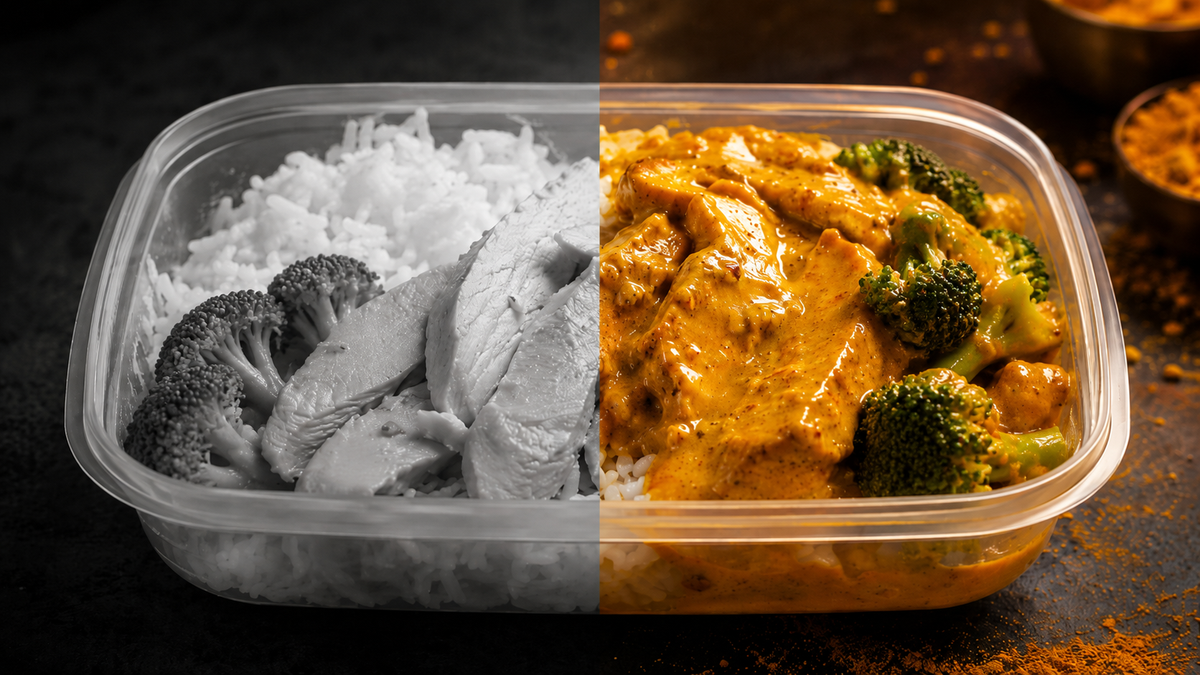
The "bro diet" — dry chicken breast, steamed broccoli, brown rice, repeat — became the default bodybuilding template in the 1970s and 1980s because it worked on paper. High protein, controlled carbs, low fat, easy to track. Coaches prescribed it, actors and athletes followed it, and the results were undeniable.
But "works on paper" and "works in practice" are two very different things.
The problem isn't just that boiled chicken is soul-crushing to eat every day for sixteen weeks. It's that flavor deprivation triggers real compensatory behavior. When food stops being pleasurable, people either binge on what they're missing, quietly quit the protocol, or push through but develop an adversarial relationship with eating that can take years to undo. Studies on long-term dietary adherence consistently show that palatability — the simple fact of whether food tastes good — is one of the strongest predictors of whether people stick to a nutrition plan.
Actors working on tight production timelines don't have the luxury of quitting. They white-knuckle it through. But for the rest of us — athletes, meal preppers, active people trying to maintain a reasonable body composition — there's no film studio signing our checks. If a diet makes us miserable, we abandon it.
The "lockup" mentality — treating food as pure function, stripping it of flavor, variety, and pleasure — is not a sign of discipline. It's a failure of design.
What Actually Needs to Happen
To build and maintain muscle, the human body needs adequate protein — roughly 1.6 to 2.2 grams per kilogram of body weight per day is the range most sports nutrition research supports. It needs enough total energy to fuel training and recovery. It needs micronutrients — iron for oxygen transport, B vitamins for energy metabolism, calcium and potassium for muscle function. And it needs all of this to arrive in a format that doesn't make you want to throw your meal prep container out the window.
That last part isn't optional. It's actually central to the whole enterprise.
The good news is that high-quality protein doesn't have to be flavorless. And flavor doesn't have to mean compromising your macros.
The Case for Savory Protein
There's been an explosion of interest in savory, sauce-format protein delivery — and it makes complete nutritional sense.
The most underappreciated fact in sports nutrition is that how you consume protein matters almost as much as how much. Protein consumed in a format that stimulates appetite, that integrates into a real meal, that actually tastes like something — gets eaten consistently. Protein consumed in a format that triggers dread gets skipped, halved, or choked down with eyes closed.
A well-formulated savory protein supplement — something designed to function as a gravy, sauce, or broth — can deliver everything a lean meat-and-rice meal provides, in a format that actually makes that meal worth eating.
Here's what the stack looks like when it's done right:
Acheta (cricket) protein is the most nutritionally complete non-conventional protein source available. Gram for gram, it is comparable to chicken breast in protein quality — delivering all essential amino acids including leucine, the amino acid that triggers muscle protein synthesis. Research published in peer-reviewed journals has confirmed that cricket protein's essential amino acid profile is comparable to that of whey, with leucine registering as the most abundant essential amino acid in both. Independently tested at 29–30g of protein per 100g of finished product, it's a serious muscle-building input, not a novelty.
Beyond protein, cricket flour naturally delivers heme iron — the form most readily absorbed by the body — at concentrations higher than spinach. It provides vitamin B12 at levels that dwarf most conventional protein sources (studies cite approximately 24 micrograms per 100g of cricket flour, roughly ten times the concentration found in salmon). Potassium. Calcium. And chitin, the fiber from cricket exoskeletons, which functions as a prebiotic — feeding beneficial gut bacteria, reducing systemic inflammation, and supporting the kind of gut health that makes everything else work better.
Bovine collagen peptides fill a gap that standard muscle-building nutrition completely ignores: connective tissue. Joints, tendons, and ligaments take the same beating that muscles do during resistance training, but recover more slowly and respond specifically to the glycine, proline, and hydroxyproline that collagen provides. Clinical research has found that collagen peptide supplementation combined with resistance exercise increased lean muscle mass and strength gains in exercise trials. It's not a substitute for a complete protein — it lacks tryptophan — but paired with cricket protein, the amino acid profile becomes broad and functionally complete.
Coconut milk powder is the fat source that transforms a protein supplement into a meal. It delivers medium-chain fatty acids — fats that the liver metabolizes rapidly, converting them to energy or ketone bodies rather than storing them. The result is satiety that lasts, energy that arrives quickly, and a rich, creamy mouthfeel that no protein isolate can replicate. This is what makes a savory sauce feel like food.
The Flavor Problem Is Solvable
A tikka masala profile — tested independently at 421 calories, 29.4g protein, 8.45g fiber, with sodium contributing to electrolyte function — poured over rice and whatever lean protein you've been eating for months does something remarkable: it makes the rice and lean protein worth eating again.
The same goes for a Thai peanut sauce, a rocoto-spiced broth, or a miso-forward gravy. The format is flexible. The macros are consistent. The compliance — and this is the point — actually holds.
This is not a philosophical position. It's a design principle. When food is enjoyable, people eat it. When people eat the right things consistently, they get the results they're after. That feedback loop is more powerful than any macro split drawn up in a spreadsheet.
What Hollywood Got Wrong (And What They Got Right)
The actors who grind through months of boiled chicken and plain rice are achieving real results through brute-force adherence. Credit where it's due — that level of discipline is extraordinary.
But they're also doing it the hard way, in an industry where the alternative is getting fired. The rest of us have options.
A savory protein sauce built on cricket protein, collagen peptides, and coconut fat hits the same macronutrient targets that those superhero diets are chasing — meaningful protein per serving, clean fat from MCTs, fiber that supports digestion — without the psychological toll of food that tastes like nothing.
The chicken-and-broccoli lockup is an outdated constraint, not a virtue. Eating for performance doesn't require suffering. It requires protein, micronutrients, and enough palatability that you'll actually do it again tomorrow.
That's the fix. It tastes like dinner.
Leave a comment
This site is protected by hCaptcha and the hCaptcha Privacy Policy and Terms of Service apply.